





Blogs to Go
Amazon 2027 FBA Fee Changes: What Sellers Need to Know
Amazon's 2027 US fee update is out. FBA fulfillment fees rise by about $0.19 per unit on average from January 15, and storage fees are rebuilt on February 1 [1]. The average hides big swings by size, price and category, so every seller needs to rerun margins per SKU before the new rates apply. Below: the dates, who pays more, the new storage and low-inventory-level rules, and a checklist.
Key dates
Most changes land on January 15, 2027, the day after the 2026 holiday peak fee period ends [2] (see our key FBA dates for 2026). Storage changes follow on February 1 [1].
| Date | What happens |
|---|---|
| Nov 5, 2026 | The lower 3D printer referral fee takes effect [1] |
| Jan 15, 2027 | New FBA fulfillment rates, size tiers, handling fees, low-price FBA changes and the apparel and shoes returns processing fee update [1] |
| Feb 1, 2027 | Storage utilization surcharge ends, unified age-based storage fee, new low-inventory-level fee logic, AWD and Multichannel Distribution changes [1] |
FBA fulfillment fees: who pays more
FBA fulfillment fees are the per-unit fees Amazon charges on each unit it fulfills, set by size tier, shipping weight and price band [2]. Amazon puts the average increase at $0.19 per unit, about 0.8% of the average selling price. Some fees rise and others fall, so each better matches the cost of fulfilling that product [1]. For background on how these fees work, see our guide to Amazon FBA fees.
Standard-size items
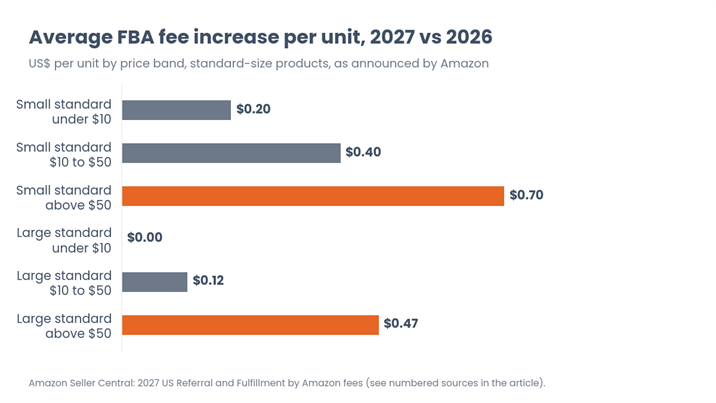
Amazon's average increases per unit for standard-size products, by price band, are [1]:
| Price band | Small standard | Large standard |
|---|---|---|
| Under $10 | +$0.20 | $0.00 (non-apparel) |
| $10 to $50 | +$0.40 | +$0.12 |
| Above $50 | +$0.70 | +$0.47 |
The rows below are a selection from Amazon's non-apparel standard-size rate card, not the full card. Fees are non-peak rates (January 15 to October 14), per unit, before the 3.5% surcharge, shown as 2026 to 2027 [2]:
| Size tier and shipping weight | Under $10 | $10 to $50 | Above $50 |
|---|---|---|---|
| Small standard, 2 oz or less | $2.43 to $2.64 | $3.32 to $3.75 | $3.58 to $4.31 |
| Small standard, 2+ to 4 oz | $2.49 to $2.72 | $3.42 to $3.78 | $3.68 to $4.34 |
| Small standard, 14+ to 16 oz | $2.95 to $2.99 | $3.96 to $4.32 | $4.22 to $4.88 |
| Large standard, 4 oz or less | $2.91 to $2.91 | $3.73 to $3.79 | $3.99 to $4.35 |
| Large standard, 3+ to 20 lb (base for the first 3 lb) | $6.15 to $6.15 | $6.97 to $7.16 | $7.23 to $7.73 |
Across these rows, large standard items under $10 do not change, and the above-$50 band gets the largest increase in every row [2].
Small standard above $50 takes the steepest hit: fees rise $0.66 to $0.73 across the small standard rows shown, for example $3.68 to $4.34 for a 2 to 4 oz item [2]. The premium for crossing the $50 line also widens from $0.26 to $0.55-$0.57 across the full standard-size rate card [2].
Low-price FBA: five categories lose the under-$10 rate
Five fee categories lose the under-$10 low-price rates from January 15 and are charged $10 to $50 rates instead: Automotive and Powersports, Compact Appliances, Musical Instruments and AV Production, Media (Books, DVD, Music, Software, Video), and Computers [1]. A small standard DVD of 2 to 4 oz at $9.99 moves from $2.49 to $3.78 (non-peak), a 51.8% jump, mostly because it now pays the $10 to $50 rate instead of the low-price rate [2]. If you sell cheap items in these categories, check this line first.
Oversize handling fees and bulky tiers
Amazon adds two handling fees for oversize items [1]. The flat product handling fee is charged on flat, thin items (shortest side under 4 inches, median side at least 25), and the overhang handling fee on items with a median side over 43 inches; products that meet both conditions pay both, on top of the FBA fulfillment fee [3]. The flat fee runs from $8.40 for small oversize to $29.53 for special oversize heavy, and the overhang fee is $3.45 for long oversize, $5.23 for special oversize light and $10.45 for special oversize heavy [3].
Amazon also re-cut the bulky and oversize tiers: the old small bulky tier splits into small and medium bulky, the old large bulky tier into large and extra-large bulky, and the extra-large tiers become six oversize tiers [1]. For a 1 lb item at $10 and above, the non-peak fee moves from $7.55 to $7.51 for small bulky and from $9.35 to $9.88 for large bulky; the new medium bulky tier costs $7.66 and extra-large bulky $10.09, and the per-pound increment rises from $0.38 to $0.39 [2]. The rates you pay until January 14 are peak rates: a 1 lb small bulky item at $10 and above costs $8.59 now and $7.51 from January 15 [2].
Stop wasting time on spreadsheets and start using what the professionals use.
Storage and the low-inventory-level fee
From February 1, Amazon eliminates the storage utilization surcharge and folds the aged inventory surcharge into the monthly storage fee, creating the unified monthly storage fee, a single age-based rate per cubic foot [1]. In Amazon's framing, stock that sells within six months pays the same or less, and slower stock pays more [1]. The Unified Monthly Storage Fee page lists the new rates [4]. They apply from February 1, per cubic foot per month from January to September; October to December adds $1.62 per cubic foot for standard-size items and $0.84 for bulky and oversize [4]:
| Inventory age (days) | Standard-size | Bulky and oversize | Clothing, shoes, bags, jewelry, watches (standard-size) |
|---|---|---|---|
| 0 to 180 | $0.78 | $0.56 | $0.78 |
| 181 to 270 | $2.78 | $2.56 | $1.78 |
| 271 to 365 | $6.68 | $6.46 | $6.68 |
| 366 to 455 | $7.68* | $7.46* | $7.68* |
| 456 or more | $8.68* | $8.46* | $8.68* |
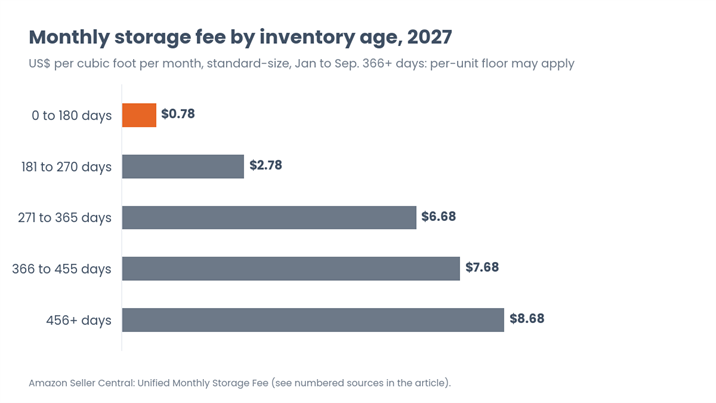
*From day 366 the fee is whichever is higher: the per-cubic-foot rate, or the base rate ($0.78 standard-size, $0.56 bulky and oversize) plus a flat $0.30 per unit (366 to 455 days) or $0.35 per unit (456 days and over) [4]. Amazon assesses the fee per FNSKU at the end of each month and bills it between the 7th and 15th of the next [4]. An FNSKU that AWD replenishes to FBA at 70% or more is billed at the 0 to 180 day rate whatever its age [4].
To see the effect on your own catalogue, the 2027 Fulfillment fee change page in Seller Central's Profit Analytics (login required) compares your current (2026) and updated (2027) fulfillment fees per product [1].
Low-inventory-level fee
The low-inventory-level fee is a per-unit charge on FBA stock that runs low. Today it is assessed on trailing 30- and 90-day sales. From February 1 it applies only when inventory falls below 28 days of supply, measured on actual shipments in the four weeks before and after the assessment date [1]. Our earlier post covers the low-inventory-level fee basics. The rate depends on the size tier and on the higher of the two days-of-supply figures [5].
Fees run from $0.32 per unit for a small standard item at 21 to 28 days of supply to $3.50 for a long or special oversize item under 14 days [5]. A large standard item up to 3 lb pays $0.97 under 14 days, $0.70 at 14 to 21 days and $0.36 at 21 to 28 days [5].
Exemptions cover your first 365 days as a new Professional seller, the first 120 days (up to 200 units) of a new-to-FBA parent product in New Selection, SKUs that AWD replenished at 70% or more over the prior 90 days, products with fewer than 20 units shipped in the last week, and grocery [5]. Amazon checks inventory weekly and charges the fee four weeks later, per unit fulfilled [5].
Other changes worth knowing
- The 3.5% fuel and logistics surcharge continues. It has applied to FBA fulfillment fees since April 17, 2026 [2], and Amazon says it will keep reviewing it [1]. No end date is given, so keep it in your 2027 cost models until Amazon says otherwise. It also extends to fees under Amazon's PanAmericas program (US to Canada) from January 15 and to AWD transportation and Multichannel Distribution fees from February 1 [1].
- Promotions get costlier. "Buy X, Get Y" promotions gain a $5 upfront fee plus a 2% variable fee capped at $2,000, and all promotions are billed monthly from February 2027 [1].
- Referral fee reductions. The announcement lists two referral changes, both reductions: 3D printers at 12% on the first $200 and 5% above, and a 10% promotional rate for Amazon Renewed through October 18, 2027 [1].
- Returns processing fee. It is updated to the new 2027 size tiers for Apparel and Shoes units shipped from January 15, and for other high-return categories from February 1 [1].
- MCF, Buy with Prime and AWD. Standard-speed MCF and Buy with Prime fees rise 3.5% on average; AWD processing is $1.55 per box and transportation $1.58 per cubic foot from February 1, and AWD inventory held over 12 months is charged 2.5 times the standard storage rate from March 1 [1].
What to do before January 15
Amazon gave sellers more than two months of notice [1]. Use it.
- Rebuild unit economics per SKU, not per account. The $0.19 average tells you little about your catalogue. Pull your current fee per SKU (our post on checking that Amazon applies the correct FBA fees helps), apply the 2027 rate for its size tier and price band, and add the 3.5% surcharge. Start with small standard items above $50, low-price categories that lose the under-$10 rate, and oversize items that trigger the new handling fees.
- Reset price floors and repricer minimums. For SKUs whose fee rises, a minimum price built on the old fee is now too low.
- Review pricing around the $50 line. With the premium for crossing $50 more than doubling, a small price move can change the fee more than it changes your revenue.
- Audit inventory age before February 1. Identify units older than six months, since they carry the higher age-based storage rate [1].
- Check days of supply on fast sellers. Under the new rule, SKUs below 28 days of supply on both sides of the assessment date can trigger the low-inventory-level fee [1].
- Model the full year. The 2027 rate cards cover only the non-peak period, January 15 to October 14 [2], and the announcement lists no peak rates [1]. Keep a buffer for late 2027 in your annual plan.
Where Profit Cyclops fits
Fee changes only matter once you see them against your own costs. Profit Cyclops shows net profit per ASIN after fees, ads, refunds and storage, with SKU-level COGS that keeps historical cost changes. Compare your margins by ASIN after January 15 with a pre-peak month such as September (December and early January still carry peak fees [2]), so you can see which products absorbed the change and which ones need a price or sourcing decision. Our post on fees an FBA calculator can overlook lists more. You can try Profit Cyclops with a 7-day free trial, or look around the demo account.
Sources (accessed November 2026):
- Amazon Seller Central: 2027 US Referral and Fulfillment by Amazon fees (requires login)
- Amazon Seller Central: 2027 US FBA fulfillment fee changes (requires login)
- Amazon Seller Central: Oversize handling fees (requires login)
- Amazon Seller Central: Unified Monthly Storage Fee (requires login)
- Amazon Seller Central: Low-inventory-level fee 2027 (requires login)